
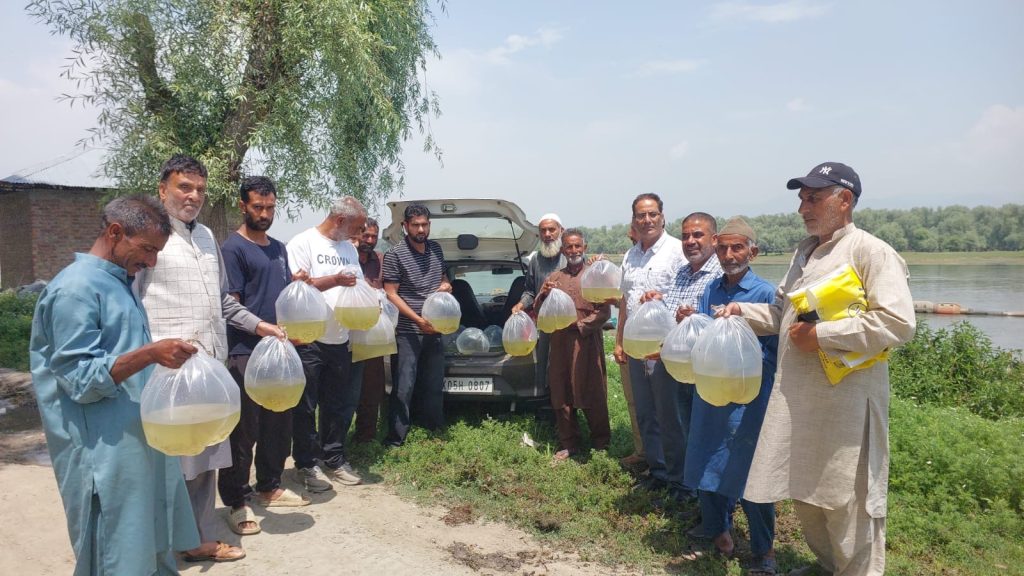
In a large-scale initiative aimed at boosting fish production and safeguarding livelihoods, the Fisheries Department Baramulla June 13 carried out a major fish seed stocking operation in Wular Lake and other prominent water bodies across the district.
More than five lakh seeds of Carp and Schizothorax varieties were released into Wular and surrounding aquatic ecosystems in Sopore, Pattan, Rafiabad, Watlab, Jahama, Ningli, and several other strategic locations.
The drive was supervised by Assistant Director Fisheries Baramulla, Showkat Ahmed, and executed with the support of field teams from across the region.
“This is part of our annual replenishment programme,” said Ahmed. “The aim is twofold — to maintain ecological balance and ensure food and income security for thousands of fishermen whose survival depends on these water bodies.”
He noted that Wular Lake alone sustains more than 20 fish species, including Trout and Carp, which are not only ecologically significant but form the backbone of the region’s inland fishing economy. “Over 10,000 families depend on Wular for their livelihood, either directly or indirectly,” he added.
Highlighting broader development under the Holistic Agriculture Development Programme (HADP), Ahmed said the department has already helped establish 100 private fishery units to promote youth entrepreneurship in aquaculture. “We’re also conducting regular awareness drives and sending youth for exposure visits to equip them with modern fish farming techniques,” he said.
Local fishermen welcomed the initiative, calling it timely and crucial. “Our entire livelihood is tied to Wular,” said a fisherman from Sopore. “This stocking will revive fish population and restore our income, especially after years of declining catch.”
Officials confirmed that similar stocking and support interventions will continue in the coming months to ensure sustained fish production and long-term welfare of fishing communities in the region.