

Jammu and Kashmir Chief Minister Omar Abdullah on December 26 delivered his strongest rebuttal yet to senior National Conference leader and party MP Aga Syed Ruhullah Mehdi over the contentious reservation policy in government jobs and professional colleges, asserting that he would not bow to threats or street pressure.
“I am not afraid of anyone’s threats, nor will I take any wrong decision under pressure. I don’t know what you think of yourself,” Abdullah said, responding sharply to Ruhullah’s recent remarks on the issue.

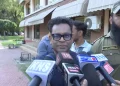
The Chief Minister underlined that sensitive matters such as reservation policy cannot be resolved through intimidation or agitation and must be addressed strictly within the constitutional and legal framework, following due consultation with all stakeholders.
Abdullah’s remarks came after Ruhullah Mehdi warned that he would personally join protesting students if the government failed to engage with them by December 27.
The MP has repeatedly accused the National Conference’s top leadership of reneging on promises made in the party’s 2024 election manifesto, which helped it return to power in the Union Territory.
Friday’s exchange has brought simmering tensions between Abdullah—also the vice-president of the NC—and Ruhullah Mehdi into the open, turning the disagreement into a public face-off within the ruling party.
At the heart of the controversy is the government’s proposed restructuring of reservation quotas.
The J&K cabinet, chaired by Omar Abdullah, has recommended increasing the open merit quota to 40% by reducing the Resident of Backward Area (RBA) quota by three percentage points and the Economically Weaker Sections (EWS) quota by seven percentage points.
If approved by Lieutenant Governor Manoj Sinha, the total reservation in government jobs and professional colleges would stand at 60 per cent, leaving 40% seats for open merit candidates across the Union Territory.
Currently, Scheduled Castes (SCs) and Other Backward Classes (OBCs) enjoy an 8% quota each, Scheduled Tribes (STs) 20%, EWS and RBA 10% each, and residents of areas adjoining the Line of Control and International Border (ALC/IB) 4%.
In addition, there is a 10% horizontal reservation, including 6% for ex-servicemen and four% for Persons with Disabilities (PwDs).
With political tempers rising and students’ protests continuing, the reservation debate is fast emerging as a major test of unity and governance for the National Conference-led government in Jammu and Kashmir.