
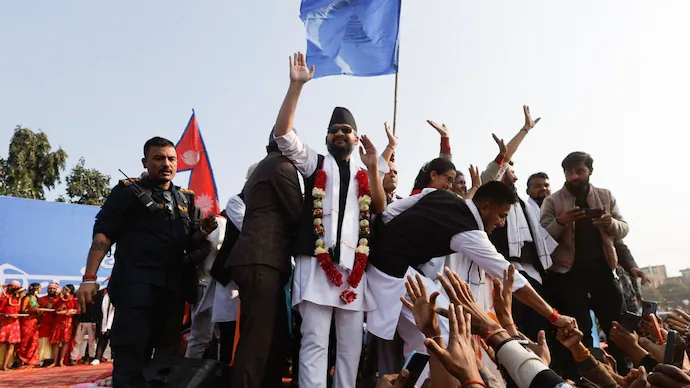
In a dramatic political upset, Balendra Shah has defeated former prime minister KP Sharma Oli by nearly 50,000 votes in Nepal’s closely watched Jhapa-5 constituency, marking a major shift in the country’s political landscape.
The young leader of the Rastriya Swatantra Party secured 68,348 votes, while Oli — chairman of the Communist Party of Nepal (Unified Marxist–Leninist) — received 18,734 votes, according to final results released by the Election Commission of Nepal. Shah’s margin of victory stood at 49,614 votes.


Early counting trends indicated that the Rastriya Swatantra Party, led by Shah, was emerging as the largest force in the 275-member House of Representatives of Nepal and appeared on course to form the next government.
Nepal held its general election on March 5, barely six months after violent protests forced the government led by KP Sharma Oli from power. At least 77 people were killed during the unrest, which shook the country’s political establishment.
The protests that erupted in September 2025 were largely driven by Gen Z demonstrators. What began as anger over a brief social media ban quickly escalated into a broader movement against corruption, economic hardship and entrenched political elites.
The contest in Jhapa-5 drew national attention as Shah — widely known as Balen Shah — had been projected by the Rastriya Swatantra Party as its prime ministerial candidate.
Oli had previously won the same constituency in the 2022 parliamentary election, defeating Khagendra Adhikari of the Nepali Congress by more than 28,000 votes. Shah’s emphatic victory therefore represents a sharp political reversal and highlights the growing appeal of newer political forces challenging Nepal’s traditional leadership.
Shah first gained national prominence after winning the 2022 mayoral election of Kathmandu Metropolitan City as an independent candidate. He served as mayor until January 2026 before stepping down to enter national politics. Soon after, he joined the Rastriya Swatantra Party and emerged as one of its leading faces ahead of the general election.
Born on April 27, 1990, in Naradevi in Kathmandu, Shah belongs to the Madhesi community, whose roots lie in Nepal’s southern plains bordering India. His family originally hailed from Mahottari District before moving to the capital.
From hip-hop to politics
The 35-year-old’s professional background is unusual in Nepal’s political arena. Shah holds a bachelor’s degree in civil engineering from the Himalayan WhiteHouse Institute of Technology and a master’s degree in structural engineering from Visvesvaraya Technological University.
Before entering politics, he was involved in rescue operations and structural mapping after the devastating 2015 Gorkha Earthquake, helping assess damaged buildings and infrastructure.
Long before his political rise, Shah was widely known in Nepal’s music scene as a rapper, songwriter and music producer performing under the stage name “Balen”. He began his music career in 2012, gaining popularity for songs that criticised corruption, poor governance and urban mismanagement.
His political campaign focused heavily on fighting corruption and giving young people a larger role in governance. The message resonated strongly with younger voters who feel Nepal’s progress has been slow and are increasingly frustrated with traditional political elites who have dominated the country’s politics for decades.
Much of Shah’s support came from Gen Z and millennial voters, whose demand for systemic political change has grown steadily in recent years.