

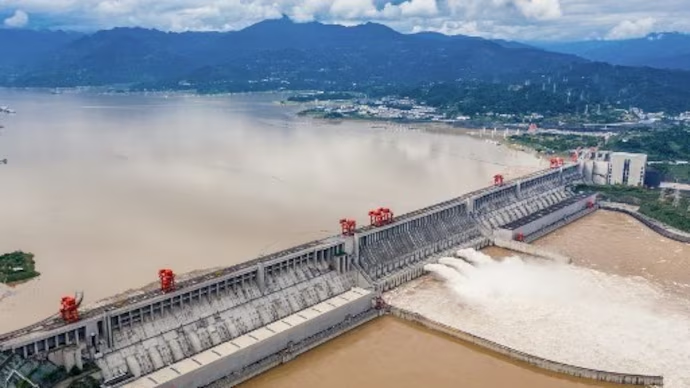
China has officially begun construction of a colossal $167.8 billion hydropower project on the Brahmaputra River in Tibet, near the sensitive India-China border — a development that has sparked significant geopolitical and environmental concerns in both India and Bangladesh.


Announced Saturday by Chinese Premier Li Qiang at a groundbreaking ceremony in Nyingchi City, the project is being touted as the largest infrastructure initiative of its kind anywhere in the world. The dam will be located on the Yarlung Zangbo — the Tibetan name for the Brahmaputra — at a sharp bend of the river just before it enters Arunachal Pradesh in India, and later flows into Bangladesh.
With an estimated capacity to generate over 300 billion kilowatt-hours annually — enough to power more than 300 million people — the mega dam will span five cascade power stations in a gorge notorious for its seismic volatility and strategic proximity to India. The entire complex is expected to cost over 1.2 trillion yuan (USD 167.8 billion), making it a defining symbol of China’s infrastructure ambitions.
However, the scale and location of the project have alarmed India and Bangladesh, both downstream nations that depend on the Brahmaputra’s waters. The construction site lies along an active tectonic zone, amplifying fears of natural disasters, including potential dam collapses or earthquakes.
India’s foreign ministry has repeatedly expressed concern over any upstream intervention that could impact river flows and affect agriculture, ecology, or livelihoods downstream. While China insists the dam will not harm the interests of lower riparian states and has promised to maintain communication, trust remains fragile.
Earlier this month, Arunachal Pradesh Chief Minister Pema Khandu called the project a “ticking water bomb,” warning it could endanger tribal populations and be wielded as a geopolitical weapon. “China cannot be trusted,” he stated, emphasizing that the dam poses a threat potentially more serious than any military confrontation.
In response, India is also ramping up its own hydropower initiatives in Arunachal Pradesh to bolster regional resilience and energy security.
India and China have maintained the Expert Level Mechanism (ELM) since 2006 to facilitate dialogue on transboundary river issues. Under this framework, China shares hydrological data with India during the monsoon season. Water-sharing and dam-building were also discussed during last year’s high-level border talks between India’s NSA Ajit Doval and China’s Foreign Minister Wang Yi.
The Brahmaputra, originating in Tibet, carves through the Earth’s deepest canyon before sweeping into one of Asia’s most flood-prone and densely populated regions. The stakes — political, ecological, and humanitarian — could not be higher as China moves ahead with one of its most audacious infrastructure gambits yet.