

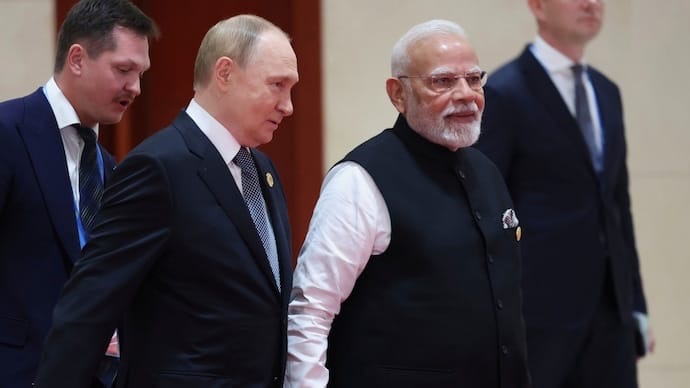
As conflict in the Middle East tightens its grip on global energy routes, Russia is preparing to redirect nearly 9.5 million barrels of crude oil toward India, offering urgent relief to a country with barely 25 days of crude reserves.
Industry sources with direct knowledge of the matter told Reuters that Russian crude — already loaded onto vessels near Indian waters — could be delivered within weeks.

The shipments, currently on non-Russian fleet tankers, were initially bound elsewhere but are now poised to be diverted as India scrambles to cushion itself from escalating disruptions in the Gulf.
A nation exposed
India, the world’s third-largest oil consumer, processes roughly 5.6 million barrels per day. Yet its stockpiles remain thin — not only for crude but also for refined fuels such as gasoil, gasoline and liquefied petroleum gas.
The urgency has intensified after vessels transiting the Strait of Hormuz — the world’s most critical oil chokepoint — were struck in attacks linked to spiraling hostilities involving Iran, the United States, and Israel. Nearly 40% of India’s crude imports pass through the narrow waterway, now effectively compromised.
An Indian government source said New Delhi has begun scouting alternative supplies in anticipation that regional tensions could persist for at least 10 to 15 days — or longer.
Moscow steps in
Russia has signaled it could cover up to 40% of India’s crude needs, according to the industry source. That would mark a significant rebound in trade flows.
Indian imports of Russian oil had dipped to around 1.1 million barrels per day in January, their lowest level since late 2022, as New Delhi navigated pressure from Washington. Moscow’s share of India’s oil imports fell to 21.2% before recovering to roughly 30% in February, industry data show.
Last month, Donald Trump said the United States would lift punitive tariffs on Indian imports after securing assurances that India would halt purchases of Russian oil. New Delhi, however, has maintained that its energy policy prioritizes diversification based on market conditions and evolving geopolitical realities.
Two refining sources said any sharp increase in Russian intake would depend on government guidance, particularly as trade negotiations with Washington remain sensitive.
From buyer’s to seller’s market
Since Russia’s 2022 invasion of Ukraine, its crude has traded at a discount. That discount may now shrink rapidly.
“It’s become a seller’s market,” the industry source said, suggesting that tightening global supply could strengthen Moscow’s pricing power.
Russia has also indicated readiness to supply liquefied natural gas after Qatar, one of India’s top LNG suppliers, halted production as the conflict expanded. Indian companies have already curtailed gas deliveries to some industrial customers to manage shortages.
Strategic balancing act
Both India and China source roughly half their crude imports from the Middle East. But unlike Beijing, India maintains far smaller strategic reserves, leaving it more exposed to sudden shocks.
In Washington, President Trump said the U S Navy could escort tankers through the Strait if required and directed the U S International Development Finance Corporation to provide political risk guarantees for Gulf shipping.
For now, India finds itself in a precarious position — balancing diplomacy with energy security — as tankers laden with Russian crude approach its shores, potentially becoming a crucial lifeline in a deepening global oil crisis.