
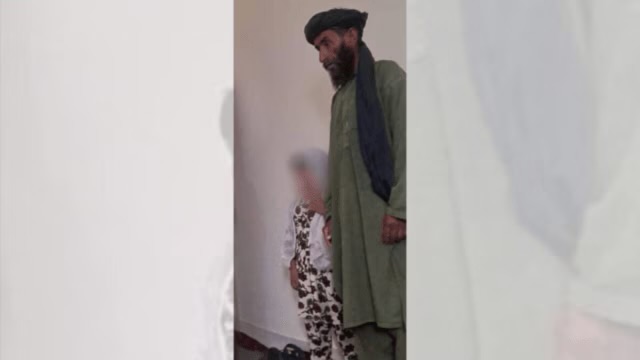
In a deeply disturbing case that underscores the brutal collapse of women’s rights in Afghanistan, a six-year-old girl has been forced into marriage with a 45-year-old man in Helmand province—with the Taliban’s de facto approval.
Rather than intervening to protect the child, Taliban authorities reportedly advised the man to wait until the girl turns nine before taking her to his home—effectively greenlighting the union.


The incident, reported by US-based Afghan outlet Amu.tv, has provoked outrage globally but remains legal under the Taliban’s interpretation of Islamic law.
Both the girl’s father and the groom — who already has two wives — were briefly detained following the marriage ceremony in Helmand’s Marjah district. Yet neither has been charged.
According to Hasht-e Subh Daily, the man paid a sum to the impoverished family in exchange for the girl, an increasingly common practice in Taliban-controlled Afghanistan, where extreme poverty and patriarchal customs have combined to erase any safeguards for girls.
Despite official statements of “horror” at images from the ceremony, Taliban leaders have stopped short of condemning or annulling the marriage.
In Taliban-ruled Afghanistan, where the legal system no longer recognizes a minimum age for marriage, such unions now persist unchecked.
A culture of sanctioned abuse
Since retaking power in August 2021, the Taliban has institutionalized gender apartheid — banning girls from school beyond the sixth grade, blocking women from most jobs, and restricting their movement and visibility in public spaces.
The resulting vacuum of protections has triggered a dramatic surge in child marriages.
UN Women reports a 25% rise in underage marriages and a 45% increase in childbearing among Afghan girls since the Taliban returned to power. UNICEF now ranks Afghanistan among the worst countries for child brides.
“Under this regime, girls are treated as property to be traded—not as children to be protected,” said one women’s rights activist who spoke on condition of anonymity.
Girls in rural provinces are often exchanged as baad — a practice where daughters are given to rival families to settle disputes — or sold for walwar, a bride price determined by the girl’s appearance, perceived purity, or health.
In every case, the child becomes namus — a symbol of family honor and control, stripped of any autonomy.
“I knew she was too young,” admitted Amiri, a mother in Uruzgan who gave away her 14-year-old daughter to a 27-year-old man for 300,000 Afghanis. “But we had no food. That money fed my family.”
ICC steps in, Taliban scoffs
In a landmark move, the International Criminal Court (ICC) recently issued arrest warrants for two of the regime’s most powerful figures—Supreme Leader Haibatullah Akhundzada and Chief Justice Abdul Hakim Haqqani — charging them with crimes against humanity for their systematic oppression of women and girls.
The Taliban dismissed the warrants, calling them “an insult to Islamic values” and claiming the court has no jurisdiction in Afghanistan. But international rights groups say the evidence is overwhelming.
“These marriages are not tradition — they are violence,” said one Afghan activist. “They steal childhoods, they destroy futures, and they are happening every day with impunity.”
A shrinking future
Before the Taliban’s return, Afghan law set the legal marriage age at 16 for girls. That code has been scrapped.
In its place, Taliban clerics apply Hanafi jurisprudence, which allows marriage at the onset of puberty. In practice, this has become a cover for legalizing unions involving girls as young as six.
Meanwhile, the regime’s grip continues to tighten. Girls are banned from high schools, universities, parks, gyms, and even amusement spaces. Women are forbidden from traveling without male guardians, showing their faces, or working in most professions.
One Taliban spokesman infamously defended the nationwide veil mandate by saying, “A woman loses her value if her face is seen by men.”
In this climate, the fate of Afghanistan’s girls grows ever more precarious.
“There’s no one coming to save them,” said Mahbob, a grassroots activist working in western Afghanistan. “They are alone, traded like cattle, and forgotten by the world.”